Presets, slippage and MEV protection
Three saved trade settings, how slippage is capped, what priority fees and tips do, and how MEV protection works per chain.
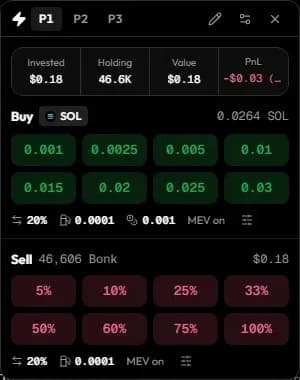
A preset is a saved set of trade settings. Hexa keeps three, P1, P2 and P3, shared by buys and sells on every chain. Switch between them in a Trenches column header, in the Instant panel, or in Settings. The trade panel always shows which one is active: P1 | Slip … | Prio … | Bribe … | MEV On.
What a preset holds
| Setting | Range | Applies to |
|---|---|---|
| Slippage | 0.1% to 50% (capped at trade time, see below) | Every chain |
| Priority fee | 0 to 0.1 SOL | Solana |
| Tip (shown as Bribe on the ticket, Jito tip in the Instant panel) | 0 to 0.1 SOL | Solana |
| MEV protection | On or off | Solana |
Edit presets under Settings → Presets, or from the sliders icon in the Instant panel, then save. A common setup is a cheap, patient P1 for normal trades and an aggressive P3 for launches where landing first matters.
Slippage
Slippage is how far the fill may be from the quote before the trade is refused. Hexa caps it by the kind of token, whatever your preset says. The current caps are:
- Memecoins and new launches: up to 20%.
- Majors (SOL, ETH, BNB and their wrapped versions, USDC, USDT, USD1, wrapped BTC and liquid-staked SOL): up to 1%.
If a preset asks for more, the cap is used and the ticket shows the capped value.
High slippage gets you filled in a fast market, but a thin pool can then fill you well below the last price shown. Lower slippage is safer and may fail more often.
Priority fee and tip (Solana)
- The priority fee is paid to the Solana network to get your transaction processed sooner.
- The tip pays a block builder to include your transaction; it is paid only when the trade is landed through a Jito bundle or a tip-based sender.
Both go to the network, not to Hexa, and are part of the trade's cost. Higher values land faster in busy moments; on a quiet chain they mostly cost more.
MEV protection
MEV bots watch for pending trades and "sandwich" them: they buy just before you and sell just after, so you fill at a worse price. What MEV protection does depends on the chain:
With MEV protection on, Hexa sends the trade as a Jito bundle, which can't be sandwiched. With it off, Hexa uses a fast sender or a standard RPC. Many Solana trades are routed through Jupiter, which then submits the transaction itself; the setting applies to the trades Hexa lands directly.
Every Ethereum trade is sent privately through Flashbots Protect, whatever the toggle says.
Trades go through a standard RPC. The MEV toggle has no effect on these chains; keep slippage tight to limit exposure.